As it turns out I have time for at least a short post, maybe more, we will see... If you read last week's post you'll know that I was away doing coffee fermentation experiments all week. I don't think I've really explained what happens so here's a quick overview: farmers bring bags of coffee to the station, it is weighed and then added to a tank of water, from which the staff should remove the cherries that float as they are damaged (still ok for Nescafe). Then the cherries are fed into a machine with a disk that spins, which removes most of the beans from the cherries. (I was trying to think of an analogous fruit to coffee so you can get some idea of what it's like, and I think that sloes are probably the closest, but the only have one seed). Then they are sorted again by floating, with the low quality beans being the ones that float. Next they are put in a tank to “ferment” - the beans are covered by a kind of mucus which needs to be removed, and if you leave them for several hours it starts to loosen and turn to slime, which can then be washed off. The final step of wet processing is to soak the beans in water for between half a day and a day – this might actually lower the quality though, so we're going to do some experiments to check whether it is actually necessary at all! Once processing is complete, the beans are moved to drying tables in the shade where huge numbers of women hand sort the beans to remove damaged ones and bits of pulp that got missed in the process. From there they are moved to the sun, until they reach 12% moisture. I was going to include pictures, but my camera is at home, so that will have to wait til next week.
As Jean-Marie is away I'm now the boss, which is a little strange! In the end the experiments didn't involve staying up all night as processing is a night long business so there are plenty of staff eager to help us out for a fiver. The first washing station we visited was about an hour and a half south of Kibuye, a city on the shore of Lake Kivu, in the West. It was pretty badly run as they didn't have enough water to process properly and several bits of the pulping machine didn't work as they should. The old fashioned processing method is seriously water inefficient – everything is moved through the system using water and then washed with more water, before being graded (by density) with even more water. The pulp should be being composted, but it really needs lime to neutralise the acids and that's expensive, so it's unfortunately left to rot which stinks and pollutes the rivers. I forgot to take any photos of the piles of pulp this week, but will next. Jan (the German) is going to experiment with creating his terra pretta using coffee pulp and hopefully turn it into a business that will operate at many washing stations in the future.
Had a bit of a hairy moment on Thursday when we got a puncture when the road was damp and slippery. As with most of the time, we were going round a bend and down a hill and the car had a little slide around, which got the adrenalin going! Fortunately our driver Jeff is good and he held it nicely and there was nothing coming the other way. It actually turned out well as we were 5 minutes from a city centre and even closer to a garage who repaired the tire for £2 (yes that's a 2)! Also fell off my bike yesterday – a car was coming the other way and so I couldn't see that there was a pile of stones on my side of the road until about two seconds before. I wasn't going too fast and managed to stop just before and only gently fly over the handle bars, getting a tiny cut. I had some Mutzig medicine and that made it all better though.
Mario has bought some coffee from farmers that we are processing ourselves outside the house (below). It's from an organic plantation where about a month ago Mario found frogs and birds nesting, something we haven't seen anywhere else! We're processing it differently, by drying the whole beans which moves sugar from the pulp into the bean, which will hopefully make a tasty espresso, I'll bring some back with me for tasting. We'll hopefully be visiting the old lady from before tomorrow to buy some cherries off her too.
Monday, 2 May 2011

Monday, 25 April 2011
Cheesy dreams can come true
First, HAPPY EASTER!! Hope everyone had a good day, I spent the morning in bed as I had been celebrating a little hard the night before, then met some Danish friends for aka benz in the evening. Aka benz what they call pork here, as in “little mercedes benz” because the Germans introduced them here pretty recently.
Here's a picture of me in my “office” where I'm writing from today. We haven't had internet at the real office for 2 weeks, but this hotel is 2 minutes away from our house + has good wireless, so is our second home. (Just as I was writing that the connection died!)

Dreams can come true... the day after writing about how good a cheese sandwich would be, I was in Kigali and found some decent bread and cheese! No pig's ear unfortunately, but that can wait. I hadn't eaten all day either as we had a meeting with the important players in the coffee industry in the afternoon, but we got distracted at lunch time by visiting a Swiss coffee roaster. You can substitute food for coffee to some degree, but it doesn't work forever. The sandwich reminded me a lot of travelling in Eastern Europe as I made it whilst driving along, using a bucket lid as a plate and my penknife to cut the cheese. Had some more cheese yesterday and then had a dream about making a cheese and onion sandwich last night!
On a food related note, here's a picture of the chilli oil I mentioned before. I hope it's not just me who thinks it looks like eye drops.

I spent all of Monday meeting the ~10 students I've started to help with their dissertations. It was pretty tiring and as I predicted it took a long time to explain to some of them what the problems were, but I think I got through eventually. That said, they they have sent us new versions of their research proposals and they haven't changed a great deal! There's also a lot of plagiarism, both from the internet and from each other, but I think it's because no one has told them they can't do it before. It's pretty obvious when in the middle of some dodgy English, up comes a passage that's perfect.
Jean-Marie is leaving for Texas on Tuesday. I thought that it might mean I had some spare time, but no - I'll be working 6 days a week for the next three weeks and staying up until 7am for a few days a week, all in the name of science! Think I mentioned it before in one of my first posts but I'll recap – coffee cherries are pulped to get the seeds (beans) out and then they are “fermented” for about 12 hours (I use the quotes because it's not anything to do with alcohol). We want to know how the quality (taste) of the coffee changes as it ferments, so will be taking bucket loads of beans and then stop them fermenting every hour. The beans start to be processed at about 3pm, and will be sampling up to 15 hours later, which is why there might be some late nights! I was the one who designed the experiment too, maybe I'm going to regret that...
I finally saw some coffee being washed last week too - the harvest is about a month late and at the nearest washing station they only just started. Here's some coffee in a tank "fermenting".

Me and Mario might have found a new species! We were talking about the thrips I mentioned last week and trying to work out how they manage to roll the leaves up, when we put two and two together and realised that normally leaf rolling is caused by viruses, and a lot of viruses are vectored by thrips. So I'd be willing to bet that that there is a coffee leaf rolling virus. I want to try and prove it, but it might have to wait unfortunately. In honour of our inspiration (we were drinking Mutzig) we will call it something mutzigae (after Mutzig beer) and it will be only the second virus found in coffee! If we're right it's pretty cool as the thrips have basically found a way to make themselves a house by eating. It's a bit like if we could walk up to a tree, bite it, and then it turned into a tree house. Here's another photo to show the real size of them:

There are a few random things I've meant to talk about before but couldn't weave in or forgot about, so here's a few random factoids. Matches here are made of wax, quite why I can't work out, but I guess that they are cheaper than wooden ones. When you drink here you get a little bit of paper with the price on, which accumulate every time you order a drink. I don't think it would work in the UK as people would try to lose the bits of paper before they pay. To get the best deal on calls here, some people have several simcards which they swap round depending on who they are calling. The problem with that though is that two of your numbers will not work at anyone time, so you have to try three numbers to get through to someone. And finally, in Burundi, there is a mobile company called Smart Mobile (I have a simcard)!
Not sure if I'll have the internet next week, what with the experiments, so don't get too worried if it's a while 'til I next post!
Here's a picture of me in my “office” where I'm writing from today. We haven't had internet at the real office for 2 weeks, but this hotel is 2 minutes away from our house + has good wireless, so is our second home. (Just as I was writing that the connection died!)

Dreams can come true... the day after writing about how good a cheese sandwich would be, I was in Kigali and found some decent bread and cheese! No pig's ear unfortunately, but that can wait. I hadn't eaten all day either as we had a meeting with the important players in the coffee industry in the afternoon, but we got distracted at lunch time by visiting a Swiss coffee roaster. You can substitute food for coffee to some degree, but it doesn't work forever. The sandwich reminded me a lot of travelling in Eastern Europe as I made it whilst driving along, using a bucket lid as a plate and my penknife to cut the cheese. Had some more cheese yesterday and then had a dream about making a cheese and onion sandwich last night!
On a food related note, here's a picture of the chilli oil I mentioned before. I hope it's not just me who thinks it looks like eye drops.

I spent all of Monday meeting the ~10 students I've started to help with their dissertations. It was pretty tiring and as I predicted it took a long time to explain to some of them what the problems were, but I think I got through eventually. That said, they they have sent us new versions of their research proposals and they haven't changed a great deal! There's also a lot of plagiarism, both from the internet and from each other, but I think it's because no one has told them they can't do it before. It's pretty obvious when in the middle of some dodgy English, up comes a passage that's perfect.
Jean-Marie is leaving for Texas on Tuesday. I thought that it might mean I had some spare time, but no - I'll be working 6 days a week for the next three weeks and staying up until 7am for a few days a week, all in the name of science! Think I mentioned it before in one of my first posts but I'll recap – coffee cherries are pulped to get the seeds (beans) out and then they are “fermented” for about 12 hours (I use the quotes because it's not anything to do with alcohol). We want to know how the quality (taste) of the coffee changes as it ferments, so will be taking bucket loads of beans and then stop them fermenting every hour. The beans start to be processed at about 3pm, and will be sampling up to 15 hours later, which is why there might be some late nights! I was the one who designed the experiment too, maybe I'm going to regret that...
I finally saw some coffee being washed last week too - the harvest is about a month late and at the nearest washing station they only just started. Here's some coffee in a tank "fermenting".

Me and Mario might have found a new species! We were talking about the thrips I mentioned last week and trying to work out how they manage to roll the leaves up, when we put two and two together and realised that normally leaf rolling is caused by viruses, and a lot of viruses are vectored by thrips. So I'd be willing to bet that that there is a coffee leaf rolling virus. I want to try and prove it, but it might have to wait unfortunately. In honour of our inspiration (we were drinking Mutzig) we will call it something mutzigae (after Mutzig beer) and it will be only the second virus found in coffee! If we're right it's pretty cool as the thrips have basically found a way to make themselves a house by eating. It's a bit like if we could walk up to a tree, bite it, and then it turned into a tree house. Here's another photo to show the real size of them:

There are a few random things I've meant to talk about before but couldn't weave in or forgot about, so here's a few random factoids. Matches here are made of wax, quite why I can't work out, but I guess that they are cheaper than wooden ones. When you drink here you get a little bit of paper with the price on, which accumulate every time you order a drink. I don't think it would work in the UK as people would try to lose the bits of paper before they pay. To get the best deal on calls here, some people have several simcards which they swap round depending on who they are calling. The problem with that though is that two of your numbers will not work at anyone time, so you have to try three numbers to get through to someone. And finally, in Burundi, there is a mobile company called Smart Mobile (I have a simcard)!
Not sure if I'll have the internet next week, what with the experiments, so don't get too worried if it's a while 'til I next post!
Monday, 18 April 2011
More prizes up for grabs!
First off, something I forgot to mention last time. When I was in Bujumbura last weekend, I saw a guy wearing a t-shirt saying “Made in Salisbury” - made me chuckle to myself. Continuing the shoelace theme (the prizes are still up for grabs by the way), I found a novel use for an ADSL (internet) cable that I bought with me. It's now outside, but will only be used occasionally, and not if it is raining – any idea what it's doing? I'm working on where the coffee is going to come from – we might buy some cherries off the lady in my last post and process it ourselves, but there is also a 10 hectare island of organic coffee too, which I quite fancy. I guess I'll bring back both a bit of both! We've finally been able to make coffee at home this week (photo below as promised NOW DONE!) – we don't have a kettle, but we do have a filter machine instead, but we don't have any filter papers for it! Instead we use the machine to boil water and then use a cool gadget of Mario's to make the coffee. It's essentially a 21st cafetiere and is very effective – like a large syringe with a filter paper at one end, that you add coffee too and then hot water, leave for a few minutes and then add a plunger too and push through into your mug.

Went to the last farms that we're working with on Thursday. They were in the North, so I've now seen three corners of the country. Coffee isn't grown in the north-east, but I should hopefully visit there as you can go on safari! On my first visit to farms I spotted that something was causing the young leaves on coffee plants to roll up really tightly. I couldn't find anything inside them then, but I obviously didn't look closely enough as I've now worked out it is caused by thrips - they are only 1-2 mm long, so I don't feel too bad for missing them the first time round! We've seen them (some species of Hoplandothrips, but no idea which) in almost every plantation we've visited, and yet I can't find anything more than one paragraph of information about them. That says they don't cause much damage, but coffee only produces flowers on last years growth, and as they attack the new leaves, it can hardly be helping! (this post, will be the second google hit for Hoplandothrips in Rwanda)
Here are the curled leaves:

And one of the little critters (I had to squash it a bit to stop it running around, so I could get a photo. Sorry.):

There's been a bit of a change of plan this week, as SPREAD recently found out that they are not receiving a lot of money that they thought they were going to be. I'll still be doing work on coffee, but am also going to be working with a company producing pyrethrum (sopywra), a natural insecticide that's produced from chrysanthemum flowers. SPREAD already have a project running with the producer, but there are also some students from the National University of Rwanda (here in Butare) that are going to be running experiments on chrysanthemum and pyrethrum. Mario's company are interested in using pyrethrum to control pests of coffee, as you can produce it organically and then use it on organic plantations. To be honest I think that it's stupid that the pyrethrum needs to be produced organically. We visited the factory on Friday and it goes though so many purification steps that there is no way the final product could be contaminated. There are 70,000 chrysanthemum farmers, so certifying them will be a massive task and they grow potatoes close by which are definitely not organic A British company are building a factory to turn the processed pyrethrum into an insecticide, so it doesn't have to be shipped somewhere and bought back, and obviously meaning more cash stays here. Anyway, I digress, I'm going to be helping the students to design their experiments, they've already done so, but most need a lot of work to make them produce any useful data. Got meetings with some of them tomorrow, might be a hard slog – already helped one student who's working on composting coffee pulp and it took about 2 hours to explain the problems and the solutions.
Here's the pymethrum factory:

I mentioned before that I had met a German guy who composts his own wastes. Well it turns out that apparently, if you add the right amount of wood shavings (to raise the carbon:nitrogen ratio), you can have a bucket in your room and it doesn't smell. I'm slightly sceptical, but considering humans expel something like 5 kg of nitrogen a year, if he's right it would be a pretty awesome source of fertiliser (35 million tonnes of N!). His other interest is terra pretta – adding charcoal to soil. It was used a lot by in the Amazon thousands of years ago, because charcoal has a huge surface area which traps nutrients. In really old soils, like those found in much of the tropics, it should really improve the soil and decrease pollution. Mario (housemate) was already going to be trying to get some experiments with it going here as he has previously used it on coffee plantations in Panama. I linked them together and we had a meeting over some beers to discuss things and hopefully we will get some plots going soon. Jan (the German) is here on his own cash, but has set up 74 plots of soybeans, using different amounts of terra pretta. The plants are still quite young but we went to see them on Thursday and it's already clear which are the controls and which have the most terra pretta, which is promising. Currently, he'll have to go back to Germany in June, as he'll run out of money, but hopefully we can work out a way for Mario's company to buy terra pretta off him so he can stay. There's been a fair bit of noise in the west about terra pretta in recent years as a potential way to sequester carbon in soils. Whether that would work in the long term is still unclear, but more of a problem is that our charcoal industry is tiny, unlike here where it is huge. Jan's ambition is to “turn Rwanda black” - I hope he's successful!
Here's Jan with some compost:

Really starting to miss decent bread (is it bad that that's the thing I miss most?). Bread here is sweet, stale and not gluteny like in England. I guess it's because they don't use decent flour, but as I was thinking the other day about how good a good cheese sandwich and a pint of pig's ear would be... I'm fairly used to having rice, goat kebabs and lager instead though, and it only costs the same as the beer at home!
Turned into a bit of a monster post. Let me know if there's anything I haven't talked about that you want to know about Rwanda.

Went to the last farms that we're working with on Thursday. They were in the North, so I've now seen three corners of the country. Coffee isn't grown in the north-east, but I should hopefully visit there as you can go on safari! On my first visit to farms I spotted that something was causing the young leaves on coffee plants to roll up really tightly. I couldn't find anything inside them then, but I obviously didn't look closely enough as I've now worked out it is caused by thrips - they are only 1-2 mm long, so I don't feel too bad for missing them the first time round! We've seen them (some species of Hoplandothrips, but no idea which) in almost every plantation we've visited, and yet I can't find anything more than one paragraph of information about them. That says they don't cause much damage, but coffee only produces flowers on last years growth, and as they attack the new leaves, it can hardly be helping! (this post, will be the second google hit for Hoplandothrips in Rwanda)
Here are the curled leaves:

And one of the little critters (I had to squash it a bit to stop it running around, so I could get a photo. Sorry.):

There's been a bit of a change of plan this week, as SPREAD recently found out that they are not receiving a lot of money that they thought they were going to be. I'll still be doing work on coffee, but am also going to be working with a company producing pyrethrum (sopywra), a natural insecticide that's produced from chrysanthemum flowers. SPREAD already have a project running with the producer, but there are also some students from the National University of Rwanda (here in Butare) that are going to be running experiments on chrysanthemum and pyrethrum. Mario's company are interested in using pyrethrum to control pests of coffee, as you can produce it organically and then use it on organic plantations. To be honest I think that it's stupid that the pyrethrum needs to be produced organically. We visited the factory on Friday and it goes though so many purification steps that there is no way the final product could be contaminated. There are 70,000 chrysanthemum farmers, so certifying them will be a massive task and they grow potatoes close by which are definitely not organic A British company are building a factory to turn the processed pyrethrum into an insecticide, so it doesn't have to be shipped somewhere and bought back, and obviously meaning more cash stays here. Anyway, I digress, I'm going to be helping the students to design their experiments, they've already done so, but most need a lot of work to make them produce any useful data. Got meetings with some of them tomorrow, might be a hard slog – already helped one student who's working on composting coffee pulp and it took about 2 hours to explain the problems and the solutions.
Here's the pymethrum factory:

I mentioned before that I had met a German guy who composts his own wastes. Well it turns out that apparently, if you add the right amount of wood shavings (to raise the carbon:nitrogen ratio), you can have a bucket in your room and it doesn't smell. I'm slightly sceptical, but considering humans expel something like 5 kg of nitrogen a year, if he's right it would be a pretty awesome source of fertiliser (35 million tonnes of N!). His other interest is terra pretta – adding charcoal to soil. It was used a lot by in the Amazon thousands of years ago, because charcoal has a huge surface area which traps nutrients. In really old soils, like those found in much of the tropics, it should really improve the soil and decrease pollution. Mario (housemate) was already going to be trying to get some experiments with it going here as he has previously used it on coffee plantations in Panama. I linked them together and we had a meeting over some beers to discuss things and hopefully we will get some plots going soon. Jan (the German) is here on his own cash, but has set up 74 plots of soybeans, using different amounts of terra pretta. The plants are still quite young but we went to see them on Thursday and it's already clear which are the controls and which have the most terra pretta, which is promising. Currently, he'll have to go back to Germany in June, as he'll run out of money, but hopefully we can work out a way for Mario's company to buy terra pretta off him so he can stay. There's been a fair bit of noise in the west about terra pretta in recent years as a potential way to sequester carbon in soils. Whether that would work in the long term is still unclear, but more of a problem is that our charcoal industry is tiny, unlike here where it is huge. Jan's ambition is to “turn Rwanda black” - I hope he's successful!
Here's Jan with some compost:

Really starting to miss decent bread (is it bad that that's the thing I miss most?). Bread here is sweet, stale and not gluteny like in England. I guess it's because they don't use decent flour, but as I was thinking the other day about how good a good cheese sandwich and a pint of pig's ear would be... I'm fairly used to having rice, goat kebabs and lager instead though, and it only costs the same as the beer at home!
Turned into a bit of a monster post. Let me know if there's anything I haven't talked about that you want to know about Rwanda.
Monday, 11 April 2011
Now with photos!
Time's really starting to fly now! Got a reasonable connection today so I can give you some more photos. First here are our house pets that I mentioned last time:

I forgot to take a photo of the house, so that will have to wait a while. Got back home on Tuesday night to find that the water wasn't working... I mentioned that they are surfacing the roads before - somewhere along the way a pipe got broken. Fortunately our landlord lives next door and he woke me up on Wednesday by banging on the gate for fifteen minutes (he does have my mobile number) and gave us a big bottle of water. It was fixed within a couple of days which was lucky – fortunately we live in the rich part of town so somebody could probably pull some strings.
Had dinner with the governor of the province last Tuesday, he's the cousin of a friend of Jean-Marie's, who is the head of the organic farming movement here (very much in it's infancy) and he wanted us to explain why organic coffee is a good idea. Jean-Marie is visiting Texas for three weeks later this month so I'm going to have some spare time so will try to put together a report explaining organic coffee, and who knows maybe something might change.
The genocide began 17 years ago this week and there are events to commemorate it, starting last week and going on until next week. Quite strangely, I put on my only purple pair of socks on the first memorial day, not knowing that purple is the Rwandan colour of mourning. Everywhere is closed in the afternoon which makes things quite difficult – right now I don't have any water or toilet paper, but we'll get by I'm sure!
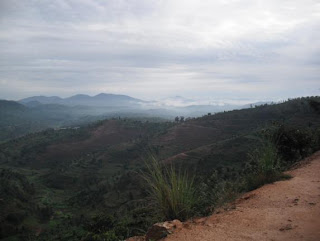
Got up at 6am on Friday to go visit some farms where they are planting more coffee trees. It was a bit of an early start but the weather was good and the views made it worthwhile:

This lady was the owner of the best coffee trees that we saw that morning. Jean-Marie was so pleased with them that he thought she should be rewarded so gave her 2500 francs (£2.50). Cash crops are often berated in the UK for decreasing food security, but to see how important that cash was to her, made me realise that that point certainly doesn't apply here. There's a hell of a lot of work to be done though to get every farmer to be like her - her plants had maybe 10 times as many berries on than average, and even that can be improved.

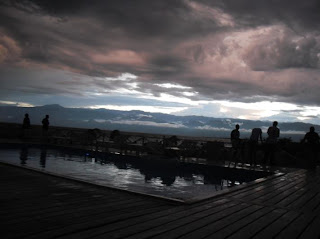
I spent the weekend in Bujumbura – the capital of Burundi. Had to pay $40 for a 3 day visa which was annoying (it used to be $20 for the visa and $20 for the customs officer) which makes me appreciate coming into Rwanda for free. I'll have to go somewhere else before I leave as I can only stay in Rwanda for 90 days and getting a proper visa sound like a lot of effort, anyway that's a bit of a tangent - Jean-Marie's wife is Burundian and has lots of family and friends there so we were well looked after. I should have looked at a map first (maybe I would have done if the internet had been working) because I didn't realise it was on the shore of Lake Tanganyika so I could have gone for a swim. Spent most of Saturday afternoon sat on the beach though which was very nice, there's a fish called makeke which is only found in Lake Tanganyika so I had one of them. It actually tasted strangely similar to mackerel though. A fair few other mzungus had also left Rwanda to go to Bujumbura for the weekend as it is the memorial week, I even found some fellow unwongereza (English) people which was the first time since arriving! There was a pretty angry storm whilst I was at the beach (such a shame as I had to buy a beer and wait it out) which I thought you'd maybe like to see:
It was quite a bit hotter in Bujumbura than here in Rwanda as it is at a lower altitude. The weather in Rwanda is pretty much perfect though – it doesn't really ever get too hot or too cold! It's the rainy season at the moment and it rains a little bit most days but often it comes down hard for an hour or so and then is sunny again. I jinxed myself on Friday by asking Jean-Marie if it ever rained in the evening – about 20 minutes later it began to pour down and continued to for hours!
Rightyo, think that's all for now folks. Don't forget to let me know what you're up to!

I forgot to take a photo of the house, so that will have to wait a while. Got back home on Tuesday night to find that the water wasn't working... I mentioned that they are surfacing the roads before - somewhere along the way a pipe got broken. Fortunately our landlord lives next door and he woke me up on Wednesday by banging on the gate for fifteen minutes (he does have my mobile number) and gave us a big bottle of water. It was fixed within a couple of days which was lucky – fortunately we live in the rich part of town so somebody could probably pull some strings.
Had dinner with the governor of the province last Tuesday, he's the cousin of a friend of Jean-Marie's, who is the head of the organic farming movement here (very much in it's infancy) and he wanted us to explain why organic coffee is a good idea. Jean-Marie is visiting Texas for three weeks later this month so I'm going to have some spare time so will try to put together a report explaining organic coffee, and who knows maybe something might change.
The genocide began 17 years ago this week and there are events to commemorate it, starting last week and going on until next week. Quite strangely, I put on my only purple pair of socks on the first memorial day, not knowing that purple is the Rwandan colour of mourning. Everywhere is closed in the afternoon which makes things quite difficult – right now I don't have any water or toilet paper, but we'll get by I'm sure!
Got up at 6am on Friday to go visit some farms where they are planting more coffee trees. It was a bit of an early start but the weather was good and the views made it worthwhile:


This lady was the owner of the best coffee trees that we saw that morning. Jean-Marie was so pleased with them that he thought she should be rewarded so gave her 2500 francs (£2.50). Cash crops are often berated in the UK for decreasing food security, but to see how important that cash was to her, made me realise that that point certainly doesn't apply here. There's a hell of a lot of work to be done though to get every farmer to be like her - her plants had maybe 10 times as many berries on than average, and even that can be improved.

I spent the weekend in Bujumbura – the capital of Burundi. Had to pay $40 for a 3 day visa which was annoying (it used to be $20 for the visa and $20 for the customs officer) which makes me appreciate coming into Rwanda for free. I'll have to go somewhere else before I leave as I can only stay in Rwanda for 90 days and getting a proper visa sound like a lot of effort, anyway that's a bit of a tangent - Jean-Marie's wife is Burundian and has lots of family and friends there so we were well looked after. I should have looked at a map first (maybe I would have done if the internet had been working) because I didn't realise it was on the shore of Lake Tanganyika so I could have gone for a swim. Spent most of Saturday afternoon sat on the beach though which was very nice, there's a fish called makeke which is only found in Lake Tanganyika so I had one of them. It actually tasted strangely similar to mackerel though. A fair few other mzungus had also left Rwanda to go to Bujumbura for the weekend as it is the memorial week, I even found some fellow unwongereza (English) people which was the first time since arriving! There was a pretty angry storm whilst I was at the beach (such a shame as I had to buy a beer and wait it out) which I thought you'd maybe like to see:

It was quite a bit hotter in Bujumbura than here in Rwanda as it is at a lower altitude. The weather in Rwanda is pretty much perfect though – it doesn't really ever get too hot or too cold! It's the rainy season at the moment and it rains a little bit most days but often it comes down hard for an hour or so and then is sunny again. I jinxed myself on Friday by asking Jean-Marie if it ever rained in the evening – about 20 minutes later it began to pour down and continued to for hours!
Rightyo, think that's all for now folks. Don't forget to let me know what you're up to!
Tuesday, 5 April 2011
Another week goes by
So another week has passed, time is starting to fly by! I've moved into my house now which is good. It's hardly luxury accommodation but as with before it is somewhere to sleep, there is no hot water and no kitchen (the only items I found there were a bottle opener and an afro comb) but for £30 a month I'm not complaining. I've got a bike now as well which is useful for getting around, but it's a road bike so isn't particularly well suited to dirt tracks. The roads around my house are being surfaced at the moment, but for now they are muddy gravel which is very sticky. The coffee is still up for grabs about the shower, and there is now another bag on offer if anyone can guess what the shoelace is now being used for. It's in by bedroom, performing a job that would not be required in England.... We have some pets, my housemate Mario is a vermiphile and so has bought his own worm farm with him. They're certainly not as cute as dogs, but they have the advantage of being a bin that doesn't need emptying and they don't need much looking after!
We visited a couple of other coffee washing stations last week, so there is now only one that we'll be working with that I haven't visited. Jean-Marie is leaving for the US in a few weeks so had to go the US embassy to sort his visa, so I spent quite a lot of time waiting around for him. The second washing station I visited was about 90 minutes drive down a dirt track from Kibuye, which is on the shore of Lake Kivu. We arrived in Kibuye at night so couldn't see anything, but the view when I woke up was awesome – I'll try to get a photo up. It was quite bizarre driving along a very bumpy dirt track to see that a fiber optic cable has already been installed alongside it, even when the roads only lead to villages. They've been laid by the South Koreans but aren't in use yet, but rural Rwanda may well end up with better broadband than much of the rural UK once it is in use!
I'm writing this as I wait for a meeting to start, we're currently running 40 minutes late but it doesn't seem to be a problem... I think it might be a bit difficult to get used to running on time once I'm back home. (next day now) The meeting ended up starting about an hour late, which isn't so bad. We were in Kigali (the capital) for a monthly meeting of SPREAD staff which went on and on and on. Originally the plan was to leave at 3, but we ended up leaving at 8.30, but the good news is that we acquired a fridge!
Rather than another Kinyarwandan update, I thought I should write about the complex sign language that drivers use here instead. The speed limit in Rwanda is only 60 kph, and therefore pretty much everyone is always speeding. Because the Rwandan equivalent of a speed camera is the police stood at the side of the road at random positions, drivers signal to each other as they drive past by pointing up (go faster) or down (go slower). When overtaking, lorry drivers help other drivers by indicating left (overtake) or right (don't) which is pretty sensible. At night things become more complicated: for some reason that I haven't quite worked out, sometimes instead of switching off full beams when another car is coming, they switch on the left indicator instead. They also flash their headlights a lot to signal that they are overtaking that they can see another car coming. I'm lucky in that SPREAD drivers are safe and sensible, but that doesn't really protect your from other road users. We had to take evasive action last week when we found a truck overtaking another round a blind corner at night (very sensible) but fortunately the roads are wide enough for three vehicles (just). In Kigali some drivers also like to use this to their benefit by overtaking entire traffic jams, which is always interesting to see.
I haven't talked about food until now either, which is slightly uncharacteristic of me. I haven't been able to cook anything here yet which is annoying me – kitchens are essentially unheard of here as most people cook on charcoal stoves and if you have any money at all you have a house boy to cook and clean for you. As I haven't had a house until recently I've been eating in restaurants which is a little dear but cheap compared to home. The standard meal out is goat kebabs which are generally pretty tasty, if sometimes a bit tough. I've had a very good goat stew with savoury bananas a couple of times as well. There are also many restaurants that have self service buffets for lunch which are pretty cheap, although when eating at them I'm glad that my antimalarial is a broad spectrum antibiotic to keep my guts intact! The local equivalent of ketchup is pili-pili which is mashed up chillis which is very fiery indeed. There's also an oil version that comes in a little bottle, which when I first saw it I thought is was medicine! What I don't quite get is why they have that but don't seem to use any chillis in normal cooking... I'm going to start cooking at home this week, as I need to save money, I'll let you all know what it's like to cook using charcoal power for everything.
Hmm, this has got rather long considering I didn't really think that much had happened last week.
Tusa garuka (I will be back)
We visited a couple of other coffee washing stations last week, so there is now only one that we'll be working with that I haven't visited. Jean-Marie is leaving for the US in a few weeks so had to go the US embassy to sort his visa, so I spent quite a lot of time waiting around for him. The second washing station I visited was about 90 minutes drive down a dirt track from Kibuye, which is on the shore of Lake Kivu. We arrived in Kibuye at night so couldn't see anything, but the view when I woke up was awesome – I'll try to get a photo up. It was quite bizarre driving along a very bumpy dirt track to see that a fiber optic cable has already been installed alongside it, even when the roads only lead to villages. They've been laid by the South Koreans but aren't in use yet, but rural Rwanda may well end up with better broadband than much of the rural UK once it is in use!
I'm writing this as I wait for a meeting to start, we're currently running 40 minutes late but it doesn't seem to be a problem... I think it might be a bit difficult to get used to running on time once I'm back home. (next day now) The meeting ended up starting about an hour late, which isn't so bad. We were in Kigali (the capital) for a monthly meeting of SPREAD staff which went on and on and on. Originally the plan was to leave at 3, but we ended up leaving at 8.30, but the good news is that we acquired a fridge!
Rather than another Kinyarwandan update, I thought I should write about the complex sign language that drivers use here instead. The speed limit in Rwanda is only 60 kph, and therefore pretty much everyone is always speeding. Because the Rwandan equivalent of a speed camera is the police stood at the side of the road at random positions, drivers signal to each other as they drive past by pointing up (go faster) or down (go slower). When overtaking, lorry drivers help other drivers by indicating left (overtake) or right (don't) which is pretty sensible. At night things become more complicated: for some reason that I haven't quite worked out, sometimes instead of switching off full beams when another car is coming, they switch on the left indicator instead. They also flash their headlights a lot to signal that they are overtaking that they can see another car coming. I'm lucky in that SPREAD drivers are safe and sensible, but that doesn't really protect your from other road users. We had to take evasive action last week when we found a truck overtaking another round a blind corner at night (very sensible) but fortunately the roads are wide enough for three vehicles (just). In Kigali some drivers also like to use this to their benefit by overtaking entire traffic jams, which is always interesting to see.
I haven't talked about food until now either, which is slightly uncharacteristic of me. I haven't been able to cook anything here yet which is annoying me – kitchens are essentially unheard of here as most people cook on charcoal stoves and if you have any money at all you have a house boy to cook and clean for you. As I haven't had a house until recently I've been eating in restaurants which is a little dear but cheap compared to home. The standard meal out is goat kebabs which are generally pretty tasty, if sometimes a bit tough. I've had a very good goat stew with savoury bananas a couple of times as well. There are also many restaurants that have self service buffets for lunch which are pretty cheap, although when eating at them I'm glad that my antimalarial is a broad spectrum antibiotic to keep my guts intact! The local equivalent of ketchup is pili-pili which is mashed up chillis which is very fiery indeed. There's also an oil version that comes in a little bottle, which when I first saw it I thought is was medicine! What I don't quite get is why they have that but don't seem to use any chillis in normal cooking... I'm going to start cooking at home this week, as I need to save money, I'll let you all know what it's like to cook using charcoal power for everything.
Hmm, this has got rather long considering I didn't really think that much had happened last week.
Tusa garuka (I will be back)
Thursday, 31 March 2011
three photos
Ok, taking the opportunity of having a reasonable internet connection to add some photos! Just realised I don't have any software to automatically resize photos so have to use printscreen and paint. I've got more I wanted to upload but the connection is a bit dodgy and I need to leave in a minute.... I'll try to add more soon.
Managed to get a few more uploaded

This is Jean-Marie talking to some kids in the far SW of Rwanda - he's very good at making people laugh and smile. He was getting them to sing or say good morning and then giving them 100RWF (10p) when they did which made them very happy.

That's me in a tea plantation at the edge of Nyungwe. There's another of me failing to stand up, but you'll have to wait to see that!

This is a shot of the rainforest I mentioned before. You can't really capture it in photos though, especially from the road, but it looks absolutely awesome.

A young coffee tree looking nice and healthy. You can maybe just about make out the berries, but they aren't ripe yet.

An action shot of Jean-Marie tying some ribbon to a coffee tree. We've marked them so that farmers keep the berries from 25 trees separate and record the weight so we can guesstimate the yield from a hectare of plantation.

Finally, an example of the intercropping I was going on about in my first post - bananas, cassava and beans all growing together - very clever!

This is Jean-Marie talking to some kids in the far SW of Rwanda - he's very good at making people laugh and smile. He was getting them to sing or say good morning and then giving them 100RWF (10p) when they did which made them very happy.

That's me in a tea plantation at the edge of Nyungwe. There's another of me failing to stand up, but you'll have to wait to see that!

This is a shot of the rainforest I mentioned before. You can't really capture it in photos though, especially from the road, but it looks absolutely awesome.

A young coffee tree looking nice and healthy. You can maybe just about make out the berries, but they aren't ripe yet.

An action shot of Jean-Marie tying some ribbon to a coffee tree. We've marked them so that farmers keep the berries from 25 trees separate and record the weight so we can guesstimate the yield from a hectare of plantation.

Finally, an example of the intercropping I was going on about in my first post - bananas, cassava and beans all growing together - very clever!
Monday, 28 March 2011
Mwaramutse (good morning)
So, it's a new week so I thought it's time for an update. As Alex kindly pointed out mzungu is actually specific to white people rather than just foreigners. On a related note, I was actually called Japanese this week by a kid, which made me chuckle.
Some fellow Brits visited us last week from the University of Bradford, who are studying a Masters in "Peace Studies" (whatever that is). They were going all around Rwanda but came by to find out how coffee has helped to generate cash for communities after the genocide. We also had a visit from a Kiwi film crew who are making a program about coffee for a show called global radar in NZ. My boss, Jean-Marie showed them his worm farm and talked about soil in a very enthusiastic way (he needs his own TV program about soil in general), which as the students said, made worms sound sexy. We sold the students some coffee that we had helped to roast a couple of weeks ago and then went out for lunch with the profits - that's the way I like to do business!
Work wise, I've been redesigning an experiment examining how fermentation time affects coffee quality. Just in case anyone's interested; the old method contained pseudoreplicates and was going to rely on staff at coffee washing stations following the method, which was quite unlikely since it could involve staying around for hours longer than normal. The new method does away with those problems as instead I'll be there, staying up all night if necessary to get better results. Also managed to cut the number of samples in half overall, which means that it's cheaper to analyse the results as fewer samples need to be cupped (tasted). It's been good to get stuck into something though and feel like I'm actually some help, rather than just tagging along! Visited another washing station on Friday, to mark some trees so that farmers keep the berries the pick from them separate so we can estimate yields in different areas. I did point out that it would seem easier if we just asked farmers how much money they earnt from their crop and how much each washing station processed in a year, but apparently they don't want to say as they might end up paying more tax. Visiting a couple more this week as we need to get them done before the harvest begins (which should be soon).
Met a German guy at a party in the week who is working on trying to compost human shit into fertiliser. He was very proud about experimenting with his own waste, apparently if you look after it right, it reaches 50C and everything nasty is killed and it doesn't smell.
Spent the weekend in Rwanda's capital, Kigali, sampling various nightclubs. Found 5000 francs (£5) on the floor in the first one which made me a happy bunny, especially as it paid for double tequilas for me and my Panamanian friend. Saturday morning was the muganda, which is when all the shops are closed and everyone is supposed to do community work, but it seems to be a good excuse for everyone to party hard the night before and then stay in bed until the afternoon. It's very nice being in a country where even though you are supposed to check out of your hotel room at 10, you can stay in bed until 12 without it being a problem.
Still haven't got my house sorted... currently in negotiations to get the landlord to buy a fridge (well you wouldn't want a warm beer would ya?) but, fingers crossed, next week, it will be sorted. Learnt some more important Kinyarwandan this week - icupa rimwe ryishe umugabo inyanza - which means - one beer killed a man in Nyanza. Unfortunately it means we always have to have at least two beers, something which I am certainly not accustomed to in England, where of course, we have a strict maximum limit of one beer per day. Some local customs just have to be adhered to though don't they!
That's all for now folks. The coffee is still up for grabs btw, the fact that my fix was negated by the shower head being replaced should be a pretty good clue.
Some fellow Brits visited us last week from the University of Bradford, who are studying a Masters in "Peace Studies" (whatever that is). They were going all around Rwanda but came by to find out how coffee has helped to generate cash for communities after the genocide. We also had a visit from a Kiwi film crew who are making a program about coffee for a show called global radar in NZ. My boss, Jean-Marie showed them his worm farm and talked about soil in a very enthusiastic way (he needs his own TV program about soil in general), which as the students said, made worms sound sexy. We sold the students some coffee that we had helped to roast a couple of weeks ago and then went out for lunch with the profits - that's the way I like to do business!
Work wise, I've been redesigning an experiment examining how fermentation time affects coffee quality. Just in case anyone's interested; the old method contained pseudoreplicates and was going to rely on staff at coffee washing stations following the method, which was quite unlikely since it could involve staying around for hours longer than normal. The new method does away with those problems as instead I'll be there, staying up all night if necessary to get better results. Also managed to cut the number of samples in half overall, which means that it's cheaper to analyse the results as fewer samples need to be cupped (tasted). It's been good to get stuck into something though and feel like I'm actually some help, rather than just tagging along! Visited another washing station on Friday, to mark some trees so that farmers keep the berries the pick from them separate so we can estimate yields in different areas. I did point out that it would seem easier if we just asked farmers how much money they earnt from their crop and how much each washing station processed in a year, but apparently they don't want to say as they might end up paying more tax. Visiting a couple more this week as we need to get them done before the harvest begins (which should be soon).
Met a German guy at a party in the week who is working on trying to compost human shit into fertiliser. He was very proud about experimenting with his own waste, apparently if you look after it right, it reaches 50C and everything nasty is killed and it doesn't smell.
Spent the weekend in Rwanda's capital, Kigali, sampling various nightclubs. Found 5000 francs (£5) on the floor in the first one which made me a happy bunny, especially as it paid for double tequilas for me and my Panamanian friend. Saturday morning was the muganda, which is when all the shops are closed and everyone is supposed to do community work, but it seems to be a good excuse for everyone to party hard the night before and then stay in bed until the afternoon. It's very nice being in a country where even though you are supposed to check out of your hotel room at 10, you can stay in bed until 12 without it being a problem.
Still haven't got my house sorted... currently in negotiations to get the landlord to buy a fridge (well you wouldn't want a warm beer would ya?) but, fingers crossed, next week, it will be sorted. Learnt some more important Kinyarwandan this week - icupa rimwe ryishe umugabo inyanza - which means - one beer killed a man in Nyanza. Unfortunately it means we always have to have at least two beers, something which I am certainly not accustomed to in England, where of course, we have a strict maximum limit of one beer per day. Some local customs just have to be adhered to though don't they!
That's all for now folks. The coffee is still up for grabs btw, the fact that my fix was negated by the shower head being replaced should be a pretty good clue.
Subscribe to:
Posts (Atom)