Tuesday, 12 July 2011

Beer rebates and defecating in buckets

My luck with money has continued – last week I thought that getting $30 was good, but this week has been much better! Just after I posted last week I went for a beer with some friends and there was a competition to win a briefcase of cash. To win you had to guess a three digit code to open it. There weren't many people there (the promoters were blasting out music making it pretty difficult to talk) and so I was lucky enough to get the first attempt. Trying to think of some lucky combination, I chose 588 (May '88) and much to my surprise, the case opened!!! There wasn't any cash inside though and the guy looked rather worried. A few minutes later they told me that the case was broken and that any number opened it. I was fairly understanding, if a bit annoyed, but my friend was adamant that they should give me the money as I had opened the case. The boss came to apologise and offered us drinks but no money, but then one of them asked if I had a credit card. I said not on me, but he gave me his phone number and told me he would call me to sort things out. Needless to say he didn't call me, but I told Jean Marie about what happened and he got on to the manager of the hotel where we were and she in turn got on to the brewery. Eventually, on Friday I got a call from a manager of the brewery who told me he wanted to meet. I was expecting some kind of excuse as to why they couldn't give me the money, but in fact he told me that beer is supposed to be enjoyable and that therefore they would give me the money the next day!!!! They wanted to let lots of Mutzig (the beer) drinkers see them giving me the prize, but unlike most of the time, hardly anyone was drinking it. We waited a few hours but eventually they did give me the cash - £400!!! It feels like a lot more here too though partly as it goes further and partly because the highest denomination note is worth £5.


As you might imagine, my new found wealth made me try and give back as much money to the brewery in one night as I could. I was still alive the next day though and had all my belongings, even if it was almost 6pm by the time I managed to get up... Unfortunately though, the next time I got a beer, the price had gone up by 10p a bottle, but I can't really complain at that.

In other news, my laptop charger has kind of died – somehow the wire coming out of the transformer got damaged cutting the connection. It does still work fortunately and using my penknife (thanks again Joe + Victoria) I cut some of the plastic off around the wire and managed get the connection sorted again along with some bits of velcro from my phone charger and laptop charger. It's still rather dodgy though, especially as my plug adaptor is temperamental and has to positioned precisely to work. I got rather confused on Friday trying to use it at the office – I couldn't work out why it wouldn't work for about 10 minutes, before realising that the electricity had gone... woops.

Finally got round to moving house into the mansion on Monday. It's a pleasant change to have a toilet seat, a washing machine (well, a maid), a kitchen and a sofa and for only £10 a month more! As you can see it's a lot bigger than the last house. I don't think I put any photos up of inside the last place, but there was basically only one room with a table and a chair so there wasn't much to see!


The biggest change though is probably Jan's nutrient recycling system – if you can remember back to sometime in March you might remember what I'm on about already. If you can't remember / didn't read the post, I'm talking about humanure. Here's out toilet (we could have got it made in mahogany too, for a touch of class):


It's a very simple system – you do your business into a bucket, then cover it with sawdust and spray a bit of water over everything. I was sceptical to it working at first and it's certainly taken a little getting used to, but there is no smell and no flies at all. The sawdust serves two functions – firstly it adds a lot of carbon, increasing the carbon : nitrogen ratio which stops ammonia being produced by bacteria, causing a stink! Secondly it forms a biofilter when it's wet which traps any smells which come out. Once the bucket is full it can be added to the compost heap – surprisingly once the temperature of the heap reaches 50C and stays there for a couple of days, anything nasty is killed off. We've done some back of the envelope calculations and worked out that globally we flush away about half of the nutrients found in the fertiliser we use each year. If you take away the huge subsidies on fertiliser in Rwanda, people here produce fertiliser worth about $0.50 a day, which when you consider that many people still earn less than $1 a day is a pretty staggering amount of cash!


Rightyo, think that's enough for this week, I'll pat muself on the back for managing to post only 10 days after the last time.

Saturday, 2 July 2011

Another country under my belt

I thought that I should try and re-establish some weekly postings after my recent slackness. (Well that was the plan, but things didn't quite work out as I will get on to later). As I briefly mentioned last time the dry season has begun. It is good news for drying clothes (and coffee) but has the downside of being very dusty and strangely enough is actually a fair bit colder than before (I was actually cold when I got into bed once this week). Although it is the dry season it does still rain sometimes, generally explosively as a storm. It's pretty easy to tell it's on the way as you can see the lightning coming towards town and the wind picks up just before it starts to rain. Saying that, I'm writing this having just got absolutely soaked coming back from town as it started raining as heavy as a shower when I was two minutes away. I'd got lucky on my way in to town though as I saw the lightning and so got my peddle on, only getting a few drops on me before I got there.

We took the coffee samples that we've collected to be processed nearby on Tuesday. We collected them as parchment so they need to be processed into green and then hand sorted so that we only have the good stuff. Jean Marie was visiting South Africa, but emailed me to tell me that we needed some inner tubes to remove the parchment and I imagined that the machine used rubber somehow to remove it. In fact there is no machine and instead our workers fill one third of an inner tube and then roll it on the floor with their foot to break the parchment. They can only fit about 150 g in at a time and so considering that we have 350 kg to get through, it's going to be a while until we can roast anything! Next door to the lab where our samples are being prepared is the real dry mill where coops can take their parchment and get it processed into green. Having seen that in action, I've seen every step of the journey coffee takes in Rwanda. Here's some guys loading the machine with parchment:


I helped Jan harvest his soy beans this week too – the same ones that I had a photo of last time. It was nice to do something relatively physical for a change instead of having someone else do everything! I spent a fair while trying to chase monkeys away who were trying to eat the beans before we could pick them. Unfortunately they're not very scared of people and even after throwing sticks at them and making lots of noise, as soon as we left their sight they would climb down from the trees again. One of the cheeky monkeys


So, as I said at the beginning I had hoped to restart weekly updates, but then I had a dodgy brochette which made me ill. I won't make things too graphic, but I was glad that there is a drain in the floor of my bathroom so that I could multitask. Fortunately it wasn't too bad and I was feeling better later on the same day. I think I'm going to have to give brochettes a miss for a while though, which is a shame, especially for my wallet as they are the cheapest food going. As I was lying in bed recovering, Jean Marie rang me to tell me that he wanted me to go to Uganda the next day and would need to leave in a few hours! It was a very unpleasant bus journey to Kigali as I hadn't eaten, was sat above the wheel (no leg room) with two bags and my ipod decided not to work – maybe the washing of it has hurt it more than I thought. To make things worse it was raining (as it had been all day – so much for the dry season) which meant that it took the best part of 3 hours instead of the normal 2. On the bright side, the hotel I was told to stay at was about 3 minutes walk from the best pizzas in Rwanda, which really sorted my stomach out nicely.

The reason to go was to learn about intercropping coffee with bananas. It's the norm in Uganda and research has found farmers can get the same yield of coffee and bananas when they are grown together, as if they grow them separately. Fairly obviously, it means they can make about twice as much money from the same area of land. In Rwanda and Burundi however, the government policies have been to stop farmers intercropping coffee with anything, even going so far as to uproot crops from farmers fields who try it. The main reason for it is that they thought that the coffee yield would decrease, resulting in less revenue for the government, rather than caring about the farmer. It's fairly understandable when coffee is such a huge proportion of their foreign revenue, but doesn't appear to be rational and they have far higher population densities than Uganda, so really need to produce as much food as possible.


Uganda was an interesting change from Rwanda. It's much more reminiscent of England (no surprise really as it was a colony) as they drive on the proper side of the road, have English plugs and there is quite a lot of land that is not farmed (and they all speak English). Not being a Belgian colony though there are no chips! Going off on a tangent... something I've been meaning to let you know about is that the Rwandan's have problems pronouncing their Rs, changing them to Ls – the result of which is that fries become flies and rice becomes lice. Anyway back to Uganda: It was really interesting to see how different the farming systems are, when the countries are so close. Farmers are much more free to plant what they like where they like and unlike in Rwanda and Burundi, farmers have chosen to plant coffee, rather than being forced to by colonialists and then their governments. The farmers we met also only grew coffee and bananas, whereas here coffee is a small part of the whole farm. Here, very few coffee farmers really know what they are doing in terms of managing the crop, meaning that they don't prune correctly or fertilise, making their yields crap. Another big difference with Ugandan coffee is that they sun dry the cherries like we have done here. For some reason though they get completely covered in mould though and the quality is fairly obviously reduced. I couldn't find out why, as even when we kept ours inside sweating away it stayed ok.


I came back richer than I left which was nice too – we got $20 a day when we where in Uganda, even though we only had to pay for dinner and beer. Then on the border a guy couldn't use his calculator and ended up giving me two and a half times more cash than he should have done! It was only for $20 but it was a nice bonus. I had more dollars but the rate they offered was bad compared to Kigali so I said no, but then one of them chased after me across the border and gave me a better rate than in Kigali. I've found that walking away is the best way to get a good deal here (not sure if I've mentioned it before) if motorbike taxis want too much (more than 30p in the day and 40p at night) you can just tell them you'll walk – as soon as you take two steps they pull up and tell you to get on for the proper price! Just remembered another thing I was meaning to write – evidently in school the first (and maybe only) English phrase kids are taught is “good morning” but they're not taught what it means and so say it at all times of the day. I tried to explain to some once they should say good afternoon, using my brilliant Kinyarwandan but unfortunately it didn't work. I tend to reply with mwaramutse (good morning) too now instead. One did actually say good afternoon to me once as I cycled past and I almost fell off my bike in shock. Saying that, I know that I've been caught out saying bonjour in the evening in France...

Think I've made up for not posting last week now.

Monday, 20 June 2011

The photos are back!

Hello again. First things first I have to start off with the great news that England beat Rwanda in the under-17 World Cup last night! I don't really care for football, but it is especially sweet to beat a country when you're living there. What was particularly funny was that Rwanda's best chance came just before we scored - I thought they had scored because everyone started cheering and then 20 seconds later we were winning (then I was the only one cheering).

Our local hotel has decided to pay the bill for the internet again so I'm going to catch up with the photos from the last few weeks.

I'll start off with this very flukey shot I got of Mario - couldn't have done it if we'd tried!


This is how we occupied ourselves one evening when we had no electricity and the floor was covered in coffee:


Here's a shot of the farm where all our coffee (except my stuff) has come from (not very exciting admittedly).


Mario found this frog there though before which is pretty cool:


This was with the students studying pyrethrum - I think you can see what I mean about it being a pretty crop...


...especially with this as the backdrop:


I have to show you this as it's pretty incredible. The plant on the left is grown in normal soil, whereas the one on the right was grown with Jan's charcoal compost - it's a pretty incredible result. I wanna try it out in England as I found a report saying it could double the profitability of potato farming in England (I'm starting my PhD in potatoes soon in case you didn't know).


On to the coffee! Here's the little roaster that we used to taste our coffee:


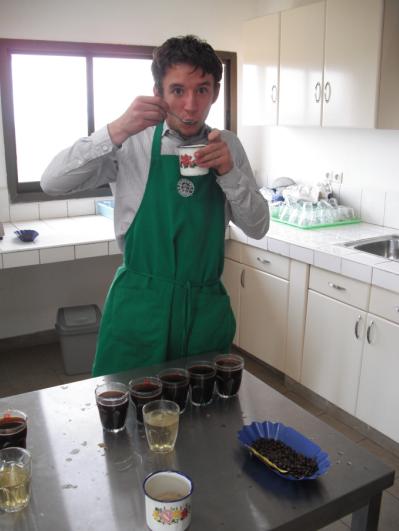
Here are the samples just before cupping:


And then me cupping - the strange look is because you're supposed to suck the coffee in hard so it coats your mouth and can taste it properly.


I finally got some money to go somewhere last week - our main mission was to go and pick up the samples from the fermentation experiment, but we're also starting an experiment composting coffee pulp. Pulp is probably best described as the arse end of coffee, as you can see:


It doesn't compost well by itself and if left alone just turns to a hot gunk. To make it go along more smoothly you can add lime and some Japanese stuff called Effective Microorganisms (EM). It seems to me a bit like snake oil - it's basically a microbial broth, but it costs ~ £3.50 a litre and that only treats one tonne! The lime is also expensive so we're using different combinations of lime and EM and will see if it's possible to do it cheaper. As another idea we are using stuff called worm tea instead of EM - it's juice which comes out of a worm composting unit used to compost pulp and is therefore dirt cheap (5p a litre). My thinking is that the microbes in it should be more suited to eating the pulp as it comes from pulp in the first place. Anyway, setting up the experiment meant lots of shovelling (7 tonnes) but as always we had plenty of people wanting to help out for £1, so it only took the morning (after starting at 6:30).


We had called the washing station manager before we arrived to check if they had EM and they said they did, but then when we got there it turned out that it had gone off last August! Fortunately we managed to get some sent to us on a bus from Butare (we were a 5 hour drive away) but it meant a lot more driving to go and get it and take it back. We didn't get back until about 9 in the evening after I had woken up at 4:30 and so I was knackered. We had to call in at the office to drop off the samples then I went to get some food and got a moto back home. When I got to my gate I realised that I didn't have my keys on me. Mario is away in Panama at the moment so I was a bit stuck... Luckily my driver was still up and nearby so he came and got me and we went to look for the keys - turned out that I left them in the door to the office (woops). In other stupid incidents I managed to wash my ipod a couple of weeks ago - I checked all my pockets, but then picked it up off the floor with all my clothes. I noticed quickly though and grabbed it out and popped it in the sun (the dry season has started now so there's no shortage of sun) and thankfully it still works! Thought that I had broken my camera too last week as I took it out my pocket and the lens was half out and it wasn't doing anything but it came back to life with some more electricity.

With not having had much to do recently I've been spending quite a lot of time hand sorting the coffee that has been milled. Even though I sorted it before there are still a lot of damaged beans to get rid of. Somehow women in Kigali manage to sort 60kg a day, but I struggle to do a kilo an hour (maybe I'm a bit too perfectionist). This is what all the crap stuff looks like:


Rightyo, think I've taken advantage of the connection sufficiently now, see ya next time!

Tuesday, 7 June 2011

So I'm late again, partly because I haven't been up to a great deal work wise and because the internet has been even crappier than usual of late. You'll have to make do without pictures again I'm afraid.

Spent (and I emphasise the spent) last weekend in Kigali which was a nice change from Butare. Money evaporates there just like in London even without having to pay to stay somewhere. Had a very good brunch (at 3pm) with some Danish friends – they had some proper bread and made pancakes with nutella. Went for a real pizza in the evening too making it a very good food day (there are pizzas here in Butare, but they are more like cheese on toast and not very good). Don't think I mentioned before that I had my first goat intestine kebab a couple of weeks ago – I didn't order it intentionally (or notice what it was at first) but after a couple of beers it was surprisingly tasty.

Been up North in gorilla country this week working with some students who are studying pyrethrum – flowers which contain insecticide (I think I talked about this before). It's hard to imagine a prettier crop to work with. Annoyingly though, most of the work I did with them so far has been wasted as it turns out that the next harvest isn't until November, which is when they need to have completed the write up by... Quite how nobody worked this out until now, months after they wrote their research proposals is a bit beyond me, but Rwandans are not particularly renowned for their planning abilities. On the plus side though, I was staying in a hotel with a hot shower, which after about two months without one was literally amazing!

As it's been a few months since I started my competition and nobody managed to get the right answers I guess I should tell you what things are being used for. My first shower leaked around the head so that nothing actually came out of the holes – the shoelace was tied around the head making the water come out as it should. When I moved, it got a new lease of life, keeping my mosquito net up (with the help of a nail I found). My internet cable is now used as a washing line – not sure if it will still work but as they only cost £1 it would be no major loss if it doesn't.

Will hopefully be moving to a new and better house soon, to where Jan is living. It's a real house with a kitchen and sofas, rather than our three rooms with no furniture. It also comes with a maid, a guard and hot water, but will only cost a little bit more than at the moment (£80 per month compared to £60). On a related theme, I've got somewhere to live once I get back too!

Learnt a couple of things about bike maintenance last week that I didn't know before – you can fix a puncture without having to remove the wheel and you can use an old inner tube to make a patch, rather than a puncture repair kit. Managed to snap the chain on my bike a week ago – not really sure how as I've never done that before – guess that my legs are too strong. It was interesting to watch a chain being fixed with a screwdriver, a rock, a nut and a spanner as well!

All the coffee we've got so far is now dry and we'll be roasting it this week! I'll let you know how everything goes next time. As I've been waiting ages to post this, we actually ended up doing some roasting today, but only some small samples that we took a few weeks ago. Had a bit of a problem with the main batch as we took it to be milled before roasting (to remove either the pulp or the parchment) but then some people tried to confiscate it off us as we're kind of not supposed to process coffee ourselves. Anyway, we got it back thankfully (we sneaked in whilst a guy was having lunch) so all is good, we just need to find somewhere else to mill it... We got to cup (taste) four of the coffees too – they certainly tasted different which is good, even though three were from the same farm, just processed differently. The natural coffee was very interesting, and not like normal coffee at all – a lot more fruity, with almost a hint of cheese (that sounds bad, but it tastes good). For cupping the samples are very weak, but we're going to try and find an espresso machine somewhere later on and then try the natural in that as it should be even better in that. I'll keep you updated.

Monday, 23 May 2011

A week late - I'm a true Rwandan now!

Hope you weren't too worried by the lack of a post last week - had a bit of a busy long weekend partying which left me a bit jaded on Monday! Writing this during a power cut at my alternative “office” - already come on and off three times which makes doing anything online a bit tricky. Already been waiting over an hour for my brochettes to arrive so I guess it might be even longer than usual – definitely going to appreciate only waiting 20 minutes for food back home. Anyway on to the real news:

Started the experiment at the fifth washing station last Tuesday. The manager looked after us very well, giving us beds, food and beer which was a pleasant change from the other places we'd been. It was good we didn't start there or we would have been disappointed elsewhere! We can't go to the last one for another week for some reason, probably because they are snowed under with cherries as the season was late to start but will finish about the same time as normal.

The week before my birthday Butare sprang into action as if they wanted everything to look great for the day – buildings were repainted, the road building went along twice as fast, potholes in other roads were filled, bunting was put up along the streets and banana trees were tied to the lampposts. As well as that, pretty much every tree along the road to Kigali (150 km) was painted white too in just one week. Turned out that it wasn't all for me though... Kagame (the President) was visiting the day after. I didn't manage to see him as I was sleeping most of the day but we saw plenty of his personal guards as he was staying in our neighbourhood. It was pretty incredible to see what can be done when people have a target to aim at, my fellow mzungus think that he should visit more often (or have a few doubles) to get things done really fast!

My birthday was a reasonably civilised affair. As I eluded to at the start I'd been out partying the three nights before so was already feeling a little tired by the time it got to Sunday. We got a fridge full of beer and some brochettes and had a good time. Getting the brochettes turned into a bit of a hassle – we had meant to make them ourselves the day before, but that didn't work out. Instead we went to a cheap bar and asked to buy 40 off them, they said that was fine, but when we rang an hour later to see if they were ready they had changed their mind and said all the goat was gone... fortunately our local hotels had plenty ready so we bought out their whole supplies and that was sufficient. Left to right we have our landlord (self-invited) Jean Marie's wife, Jean Marie, Yours truly, Jan, Coucou, Zeta and Mario. (I hope you like my attempt at photoshopping using Paint!)


The coffee processing continues apace. Got home last week to find another 80 kg that needed drying and there is more on the way. Found out that it would cost $150 to take an extra bag back with me which makes my exporting plans more complicated! I think I'll have to just strap coffee to the outside of my bags and then surround them in gaffer tape. It might end up looking a bit strange, but it seems worth it to save the cash! Some of the first batches should be dry enough soon for us to cup, which will be great. Been doing some hand sorting as well which is very time consuming – think we might have to employee a few workers at some stage to get it done faster. Here's our sitting room (and kitchen and dining room) last week (there's been more added since):


Had no power at our house for the last few days which is a bit annoying. Houses on the other side of our road do so it must be a local fault which might take a while to repair. The forces that be seem to want us not to drink coffee – our grinder broke a few weeks ago and we can't find a replacement anywhere (fortunately another intern is coming from the US next week and is bringing one). I resorted to using a saucepan to crush beans which took about half an hour to make three cups (still worth it)! Finally we managed to get hold of some ready ground coffee and then the electricity went so we can't make hot water! Hopefully next week things will get back to normal. (After I wrote this, some guys came round to fix it, the “hour” has already turned into five hours, but it should get fixed today).


Visited a new school last week which was built by the American supermarket that Mario's company sell coffee to. It's a secondary school for girls (over here that means ages from 17-20ish) with a strong focus on science and technology. They aim to become self-sufficient for food, having around 5 hectares of land. We went there because they are hiring a farm manager and Mario was helping to interview. It was a really impressive place and they are going to start using worms for composting, as well as terra preta on their soil. It's a beautiful location too, although being about 800 m lower than Butare was a bit hot for me.


Realised I never updated you on my Kinyarwandan. It's coming along fairly well, I still can't really talk to people who speak no French or English but maybe with a few months more work I'll be able to. I finally got round to learning to count last week; it's difficult compared to all European languages as the words are all at least three syllables and bear no resemblance to our numbers, but it helps to get things for cheaper. They use the same word for tomorrow and yesterday, which at first seems stupid, but in fact is pretty sensible since you can always tell from the tense which of the two someone is talking about.

Finally, I've been meaning to say for ages that I don't like the design of the blog, but I can't work out how to change it... oh and I'm curious as to who is following this in Singapore, care to identify yourself? Hmm, actually one more thing I've been meaning to post for ages, here are the five types of coffee, from left to right, cherry, parchment, green, roasted and ground:


Hopefully that makes the rest of what I talk about make more sense.

Sunday, 8 May 2011

Ikawa y'umuzungu

First I'll catch up with the photos I meant to add last week.

Here's a mountain of coffee cherries waiting to be pulped:


The cherries go through this machine before being graded with water to try and remove more of the pulp, before being put in a tank to ferment.


These guys dance around in the tank once fermentation is complete to remove the mucilage from the beans. After I took this one of the guys asked me if I had any other shoes... I thought he was meaning that I should get in the tank and help, but he was actually wanting me to give him my shoes. I tried to explain that I only have one pair of shoes so I needed them!


This is the set up for our experiments. Our assistant is washing one of the samples in a sack to get rid of the mucilage after fermentation.

And to show you what's going on in each bucket:

Finally the last photo from last week is this of our washing station (more of a drying station):

So now onto this week... Had Monday off as we were working on Saturday. Stayed up until 2am in the evening washing more coffee that Mario had bought earlier in the day (powered of course by coffee). On Tuesday we were supposed to set off for a washing station near Tanzania, but for some reason the manager won't let us do the experiment at the moment. Instead we headed for a different one that would take us. It was a pretty place with a canteen (well brochettes) and a bar (warm beer unfortunately) but there was also a hospital 10 minutes away with better food and cold beer! I bought some coffee there as it is at high altitude which should make it tastier. I bought 25kg of cherries for £10, which meant the farmer got more than three times the cherry price last year, and about a third more than this year (coffee prices have rocketed). We processed it ourselves there.

First we hand sorted the cherries to remove any that where unripe (left to right it is Vital, a technician with SPREAD, Jeff our driver and then the farmer). I only bought the ripe ones, the others will end up in some crap instant coffee.

After that we put them in buckets of water and removed any cherries that floated as they have been damaged by insects (I've got a photo, but it isn't very interesting). The washing station had a hand pulper which made the next step a lot easier than it could have been (Mario got people top pulp his with stones). As avid facebook stalkers will have already seen I helped with the pulping as well.


Then we floated them again in water to remove more damaged beans. Rather than fermenting, I put the coffee straight on a drying table which should make the coffee sweeter as the bean absorbs the mucilage. They make coffee like it in Panama and it's supposed to make good espresso. It takes longer to dry though as there is a lot of slime that needs to dry. I spend a couple of hours on Thursday hand sorting it to remove more damaged beans that don't float, as well as any that got broken in the pulping process. The staff at the washing station were quite amused by me not fermenting and then me hand sorting it, as it's normally girls work. It's drying at my house as I type, here's it yesterday (it's at the back, up against the wall):


If you think it looks unheigenic, don't worry the beans are in their own little paper bags that get removed before roasting and then the roasting will destroy all life as well.

Continuing the week, the next washing station we were going to go to was shut down because it was smelling too bad - all the pulp and waste water can stink pretty bad if it isn't dealt with correctly. SPREAD helped them sort it last year, but they needed to buy some products do deal with it, and they hadn't bothered to buy them again this year until they were shut down! Should hopefully get there next week though. So we tried another washing station, but this time the manager wouldn't let us come because they and SPREAD are in disagreement about who owes who money! Finally we did find a washing station to take us on Friday, about half an hour from Butare. Got about 5 hours sleep as we had to be at the washing station for 5:30. I helped some girls sort pulp from the low grade coffee on Saturday morning as I was bored. As usual they wanted amafaranga, but I couldn't explain that I'm in debt and not being paid (now I can: fiti idemi na ntago mbona umushahara). They had to settle for me taking a photo instead:


Hopefully we'll get the last of our experiments sorted this week by the time Jean Marie returns! Oh and I should have said earlier, that ikawa y'umuzungu means the white person's coffee.

Monday, 2 May 2011

Still alive (just)

As it turns out I have time for at least a short post, maybe more, we will see... If you read last week's post you'll know that I was away doing coffee fermentation experiments all week. I don't think I've really explained what happens so here's a quick overview: farmers bring bags of coffee to the station, it is weighed and then added to a tank of water, from which the staff should remove the cherries that float as they are damaged (still ok for Nescafe). Then the cherries are fed into a machine with a disk that spins, which removes most of the beans from the cherries. (I was trying to think of an analogous fruit to coffee so you can get some idea of what it's like, and I think that sloes are probably the closest, but the only have one seed). Then they are sorted again by floating, with the low quality beans being the ones that float. Next they are put in a tank to “ferment” - the beans are covered by a kind of mucus which needs to be removed, and if you leave them for several hours it starts to loosen and turn to slime, which can then be washed off. The final step of wet processing is to soak the beans in water for between half a day and a day – this might actually lower the quality though, so we're going to do some experiments to check whether it is actually necessary at all! Once processing is complete, the beans are moved to drying tables in the shade where huge numbers of women hand sort the beans to remove damaged ones and bits of pulp that got missed in the process. From there they are moved to the sun, until they reach 12% moisture. I was going to include pictures, but my camera is at home, so that will have to wait til next week.

As Jean-Marie is away I'm now the boss, which is a little strange! In the end the experiments didn't involve staying up all night as processing is a night long business so there are plenty of staff eager to help us out for a fiver. The first washing station we visited was about an hour and a half south of Kibuye, a city on the shore of Lake Kivu, in the West. It was pretty badly run as they didn't have enough water to process properly and several bits of the pulping machine didn't work as they should. The old fashioned processing method is seriously water inefficient – everything is moved through the system using water and then washed with more water, before being graded (by density) with even more water. The pulp should be being composted, but it really needs lime to neutralise the acids and that's expensive, so it's unfortunately left to rot which stinks and pollutes the rivers. I forgot to take any photos of the piles of pulp this week, but will next. Jan (the German) is going to experiment with creating his terra pretta using coffee pulp and hopefully turn it into a business that will operate at many washing stations in the future.

Had a bit of a hairy moment on Thursday when we got a puncture when the road was damp and slippery. As with most of the time, we were going round a bend and down a hill and the car had a little slide around, which got the adrenalin going! Fortunately our driver Jeff is good and he held it nicely and there was nothing coming the other way. It actually turned out well as we were 5 minutes from a city centre and even closer to a garage who repaired the tire for £2 (yes that's a 2)! Also fell off my bike yesterday – a car was coming the other way and so I couldn't see that there was a pile of stones on my side of the road until about two seconds before. I wasn't going too fast and managed to stop just before and only gently fly over the handle bars, getting a tiny cut. I had some Mutzig medicine and that made it all better though.

Mario has bought some coffee from farmers that we are processing ourselves outside the house (below). It's from an organic plantation where about a month ago Mario found frogs and birds nesting, something we haven't seen anywhere else! We're processing it differently, by drying the whole beans which moves sugar from the pulp into the bean, which will hopefully make a tasty espresso, I'll bring some back with me for tasting. We'll hopefully be visiting the old lady from before tomorrow to buy some cherries off her too.